Political parties have until Thursday, 15 October 2026 to submit to the
Independent Electoral and Boundaries Commission the names and specimen signatures of their authorised persons, the first of four deadlines falling this year that will shape whether women, youth, persons with disabilities, older members of society, and minority and
marginalised communities appear on the ballot in the General Election of Tuesday, 10 August 2027.
The deadline is contained in Gazette Notices 13497 to 13503, published in the Kenya Gazette Vol. CXXVIII, No. 144 (Special Issue) of 20 August 2026, in which the IEBC issued the full electoral timetable for the 2027 General Election. Three further deadlines follow before the year ends. Political parties must have their nomination rules certified by the Registrar of Political Parties by Friday, 30 October 2026, must submit those certified rules to the IEBC by Friday, 6 November 2026, and every
intending candidate becomes subject to the harambee restriction from Wednesday, 9 December 2026.
The nomination rules deadline carries the greatest consequence for Special Interest Groups. Nomination rules govern how a party conducts its primaries and how it compiles the party lists from
which the twelve special interest seats in the National Assembly and the four in the Senate are filled. A party that lodges rules making no provision for the nomination of youth, persons with disabilities or minorities on 6 November 2026 has, in practical terms, settled that
question for the entire electoral cycle. The next opportunity arises in 2032.
A mandate exercised across the full electoral cycle
The National Gender and Equality Commission is established under
Article 59 (4) and (5) of the Constitution and the National Gender and Equality Commission Act, No. 15 of 2011. Section 8 (b) of the Act mandates the Commission to monitor, facilitate and advise on the integration of the principles of equality and freedom from discrimina-
tion in all national and county policies, laws and administrative regulations. Section 8 (d) obliges it to coordinate and facilitate the mainstreaming of the issues of gender, persons with disability and other marginalised groups in national development.
On that basis the Commission monitored the 2022 General Election and published its findings in the report, Involvement and Participation of Special Interest Groups (SIGs) in the 2022 General Elections in Kenya. The Commission deployed 104 monitors and recorded 3,000 observations across 44 of Kenya’s 47 counties between 29 May and 6 August 2022. The report is the evidence base against which the Commission now reads the 2027 timetable.
What the Commission documented in 2022
The 2022 findings describe an electoral process that was open in law and uneven in practice. Sign language services were recorded in 1 per cent of the campaign sessions monitored. Campaign materials in large print appeared in 30 per cent. Local languages were used in 37 per cent. Youth candidates attended 42 per cent of the rallies ob-
served and women candidates 40 percent, but only a few rallies organised by Special Interest Group candidates were covered by mainstream television or radio.
Campaign finance was the sharpest constraint. Sixty per cent of Special Interest Group candidates financed their campaigns from friends and relatives. Twenty-seven per cent received sup-port from their political parties. Seven per cent relied on community organi-
sations, loans and savings. About half described the shortfall as high. Many, the report records, worked alongside financially stronger candidates simply to secure a platform on which to present
their manifestos.
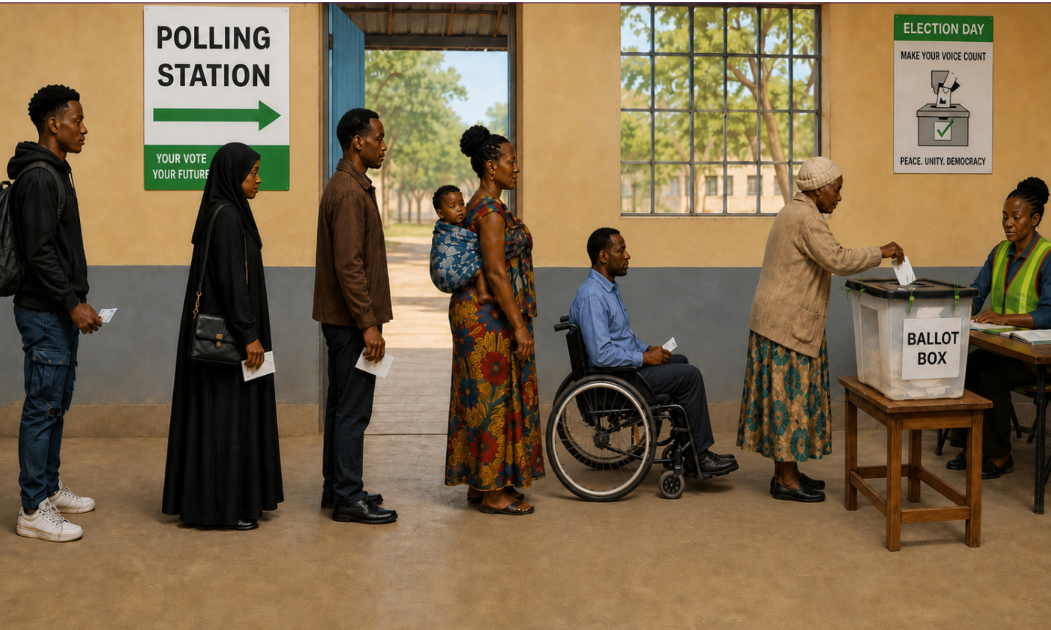
On polling day, one in five polling stations monitored was inaccessible to persons with disabilities and older persons, mainly for want of ramps, because of narrow entrances and staircases, or be-
cause the station sat on difficult ground. Seven per cent of stations had an electoral official with a disability. Nearly none offered sign language interpretation. In 47 per cent of observations, voters complained that the Kenya Integrated Election Management System kits failed to identify them, a problem reported most acutely among older persons whose fingerprints were worn. At the tallying stage, monitors recorded 36 instances in which accredited persons
with disabilities were denied entry to tallying centres.
The report’s third recommendation speaks directly to the timetable now in force. It states that failure to adhere to electoral timelines has a direct effect on the meaningful participation of SIG candidates, observers and voters, because such groups rarely receive infor-
mation about changes to the electoral plan and are therefore excluded from the decisions that follow.
The 2027 timetable is not uniform across seats
The gazette notices set different campaign periods for the six elective seats. Campaigns for President, Member of the National Assembly and Senator run for 71 days, from Saturday, 29 May 2027.
Campaigns for Member of County Assembly run for 67 days from Wednesday, 2 June 2027, and for County Governor for 66 days from Thursday, 3 June 2027. Campaigns for County Woman Member to the National Assembly run for 62 days, commencing Monday, 7 June 2027, the shortest window of the six.
The County Woman Member seat was created under Article 97 (1) (b) of the Constitution to advance the representation of women in the National Assembly. Its campaign window is nine days short-
er than that available to candidates for the National Assembly and the Senate. The Commission is examining the implications of this difference for equality of opportunity under Articles 27 and 81
(b) of the Constitution and will pursue the matter through technical engagement with the IEBC.
A party that lodges rules making no provision for the nomination of youth, persons with disabilities or minorities on 6 November 2026 has, in practical terms, settled that question for the entire electoral cycle.
The party list remains the most direct route
Political parties must submit their party lists to the IEBC by 25 June
2027. Those lists determine who fills the twelve special interest seats in the National Assembly reserved for youth, persons with disabilities and workers, the sixteen seats reserved for women in the Senate, and the four Senate seats reserved for youth and persons with dis-
abilities. Aspirants seeking nomination through this route are not helped by waiting until June 2027. The composition of the list is shaped by the nomination rules certified in October 2026 and lodged with the IEBC in November 2026.
The 2022 report recommended that the Registrar of Political Parties enforce sections 25 (2) (a) and (b) and 26 (1) of the Political Parties Act, which bar a party from drawing on the Political Parties Fund where more than two thirds of its office bearers are of the same gender or where its governing body has no representation of special interest groups, and which require that at least 30 per cent of the Fund be applied to promoting the representation of women, persons with disabilities, youth, ethnic and other minorities and marginalised communities.
Campaign financing rules apply for the first time under new regulations
Gazette Notice 13503 sets the campaign financing timelines under the Election Campaign Financing Act and the Election Campaign Financing Regulations, 2026 (L.N. 142 of 2026). Parties and candidates must open a campaign financing account and submit its details
to the IEBC by Wednesday, 10 February 2027. Party candidates must file a preliminary nomination expenditure report by Tuesday, 8 June 2027. Final expenditure reports from candidates, parties and independent candidates fall due on Monday, 22 November 2027, more than three months after polling day.
The obligation does not end on election night. A candidate who wins, loses or withdraws still carries a reporting duty into November 2027. The 2022 report recommended enforcement of campaign financing law precisely because unwritten and undisclosed campaign finance expectations operate to the disadvantage of candidates from Special Interest Groups.
The same date carries a second obligation
Wednesday, 10 February 2027 is also the last day on which a public
officer intending to contest may resign from public office. The gazette notices set no extension and provide no discretionary window. For teachers, county officers, national government administrative officers, staff of state corporations and others whose employment status is not always self-evident, the Commission advises that status be confirmed in writing with the appointing authority and with the IEBC well before the date, and not in the weeks preceding it.
What the Commission expects, and from whom
The Commission’s position, drawn from its 2022 findings and its constitutional mandate, is that inclusion in2027 is determined by decisions taken in the next four months, not by conduct on polling day.
The Commission calls on political parties to open their nomination rules to scrutiny before certification on 30 October 2026, to publish those rules in accessible formats, and to demonstrate compliance with the Political Parties Act on the composition of governing bodies
and the use of the Political Parties Fund. It calls on the IEBC to budget for the reasonable adjustments the 2022 report identified, including accessible nomination and polling venues, sign language interpretation, and voter registers printed in large and legible type, and to confirm accessibility arrangements at nomination venues ahead of the nomination window in June 2027.
It calls on aspirants from Special Interest Groups to treat October 2026 rather than June 2027 as the start of their campaign, to secure Chapter Six clearance early, and to record and report any discrimination, harassment or violence encountered in the course of seeking nomination. The Commission will continue to monitor the electoral process through to the conclusion of post-election reporting in November 2027, and will report its findings publicly.
The Commission will continue to monitor the electoral process through to the conclusion of post-election reporting in November 2027, and will report its findings publicly.
The National Gender and Equality Commission is an independent constitutional commission established under Article 59
(4) and (5) of the Constitution of Kenya. This information is provided for public education only. The Commission does not
support, endorse or oppose any political party, candidate or aspirant. Aspirants and political parties should confirm all
electoral dates and requirements directly with the Independent Electoral and Boundaries Commission.