
The National Gender and Equality Commission (NGEC) has asked Parliament to require the Kenya National Educational Assessments Council to provide reasonable accommodation to candidates at no additional fee.
The Commission proposes replacing clause 28 of the Kenya National Educational Assessments Council Bill, 2026 with an accessible procedure for requesting accommodation at registration or at any later stage when a need arises. The memorandum notes that a candidate may acquire a disability or identify a need after registration, so early disclosure should not become an absolute condition.
INDIVIDUAL DECISIONS
The Council would determine requests individually and in time for the assessment, consult the candidate and, where appropriate, the parent or guardian, give written reasons and provide an urgent review of refusals.
The lack of a disability registration certificate would not alone prevent an assessment of need or interim support. Accommodation would preserve the essential competency assessed and extend to formative, summative, practical and digital assessment, and the Council’s funds would cover accessible materials, personnel and technology.
"Accommodations shall include appropriate formats, Kenyan Sign Language, Braille, assistive technology, communication support, additional time and suitable venues according to individual need.” NGEC memorandum on the Kenya National Educational Assessments Council Bill, 2026
REGISTRATION WITHOUT EXCLUSION
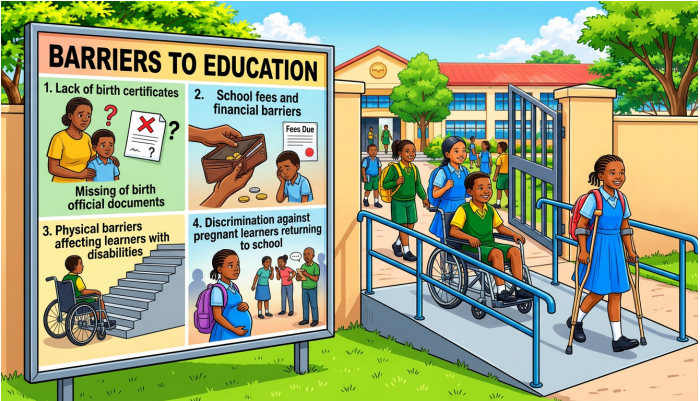
Clause 27 relies on an online platform, signatures and specified identity documents. The Commission warns that these requirements may exclude older learners, candidates with communication or physical impairments, displaced persons and people whose births were not registered. It proposes assisted offline registration, an alternative identity verification procedure, and a prompt correction and late-registration procedure where an omission arose from institutional error, displacement or disability-related barriers. A candidate would bear no penalty caused solely by institutional error.
CENTRES AND SCREENS
Before hosting candidates elsewhere or merging centres, the Council would consult those affected and arrange accessible venues and transport, so that distance, cost or disability does not exclude a candidate. The memorandum names girls facing unsafe travel among those at risk. On digital assessment, the Commission warns against turning electricity, connectivity or device availability into assessment criteria. It proposes that the Council verify accessibility, equipment, connectivity and contingency arrangements before using an e-assessment platform, provide an equivalent alternative where digital participation is not reasonably possible, and ensure that technical failure beyond a candidate’s control does not reduce a score.
The Commission’s assessment of Grade 10 placement noted that KNEC registration already requires candidates with special needs to submit medical and assessment reports. The memorandum seeks to ensure that missing paperwork does not translate into missing support.