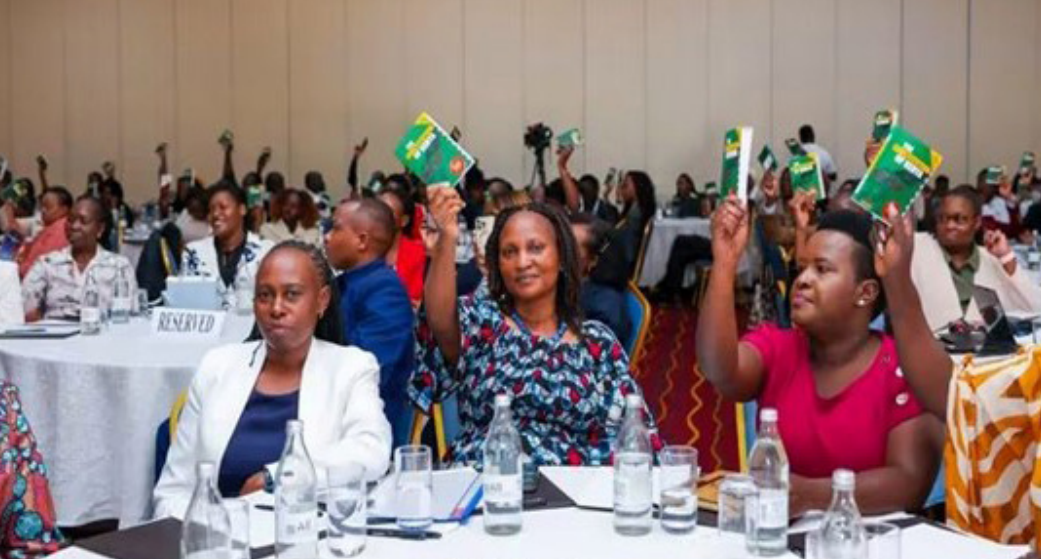
The National Gender and Equality Commission (NGEC) convened a high-level policy dialogue in Nairobi on 2 October 2026 on practical mechanisms for realising the not more than two-thirds gender principle.
The dialogue was held ahead of the 2027 General Election at Mövenpick Hotel Nairobi, in partnership with UN Women Kenya and the Kenya Women Parliamentary Association (KEWOPA). It brought together legislators, senior government officials, constitutional commissions, electoral institutions and other stakeholders.
Among those attending were the Cabinet Secretary for Gender, Culture and Children Services, Hon. Hanna Wendot Cheptumo, NGEC Chairperson Hon. Rehema Jaldesa, IEBC Commissioner Dr. Anne Nderitu, Members of Parliament Hon. Beatrice Elachi and Hon. Esther Passaris, former Deputy Speaker of the National Assembly Hon. Ruth Odinga, and nominated Senator Hon. Essy Okenyuri.
THE CONSTITUTIONAL DUTY
Article 27 (8) of the Constitution requires the State to take legislative and other measures to ensure that no more than two-thirds of the members of elective or appointive bodies are of the same gender. Article 81 (b) requires the electoral system to comply with the principle in relation to elective public bodies.
Parliament has not enacted legislation providing a comprehensive mechanism for achieving the principle at the national elective level. The Commission’s chronology of the issue records a succession of legislative initiatives and judicial interventions since the promulgation of the Constitution, with previous proposals failing to achieve enactment.
THE TWO BILLS
The current legislative window centres on the Constitution of Kenya (Amendment) (No. 2) Bill, Senate Bill No. 16 of 2025, and National Assembly Bill No. 29 of 2025. The Commission’s analysis identifies the Senate proposal as seeking to replicate the gender top-up mechanism provided for County Assemblies under Article 177 (1) (b), while providing a mechanism to address the composition of Parliament where the electoral outcome does not meet the constitutional threshold.
The approach seeks to address the constitutional requirement after voters have exercised their electoral choice, rather than altering the existing constituency-based electoral system. Under the proposals, additional seats would be allocated to qualifying political parties in proportion to their electoral performance, using party lists prepared in accordance with the proposed framework. Women accounted for 49.12 per cent of Kenya’s registered voters in the 2022 General Election, while women currently constitute about 23 per cent of the National Assembly.
Nderitu set out the role of the Independent Electoral and Boundaries Commission in aspects of political party nominations, the review of applicable party lists, the development of guidelines, and engagement with political parties and stakeholders to promote inclusive participation.
Stakeholders also drew attention to the wider barriers affecting women’s participation in electoral politics, including political party nomination processes, access to campaign resources, violence against women in elections and technology-facilitated abuse.
The Commission has been involved in the two-thirds gender agenda for more than a decade, including convening the Technical Working Group established in 2014 and presenting memoranda to Parliament on legislative proposals.
It reaffirmed its commitment to providing technical support and working with Parliament, the Independent Electoral and Boundaries Commission and the Registrar of Political Parties towards a workable mechanism for implementation.
The Chairperson of the National Gender and Equality Commission (NGEC), Hon. Rehema Jaldesa, has called for income security for Kenyans aged 60 to 69.
She delivered the call at the International Day of Older Persons commemoration in Rachuonyo East Sub-County, Homa Bay County, hosted by Warmth Initiative for Older Persons, a community-based organisation serving older persons in the area.
The initiative is led by Mr. Kenwilliams Nyakomitah, Commissioner of the Independent Policing Oversight Authority (IPOA). IPOA Chairperson Duncan Ojwang Oburu also attended. Jaldesa began the day with a courtesy call to the Deputy County Commissioner’s office and planted a commemorative tree before joining older persons and partners for the commemoration.
THE TEN-YEAR GAP
The Constitution recognises an older person at 60. The Older Persons Cash Transfer begins at 70. In Homa Bay County alone, more than 39,000 residents are aged between 60 and 69.
Jaldesa urged the State Department for Social Protection and Senior Citizen Affairs and the National Treasury to set out a clear path to income support for this group, starting with farmers, fishers and informal workers without pensions.
WHAT WAS ASKED
The Commission called for health services that reach homebound older persons, including Social Health Authority registration. It asked for legal aid on wills and succession, and for police gender desks that treat elder abuse as urgent.
It asked the County Government to publish timelines, locations and budgets for its planned care centres for older persons. Ahead of the 2027 General Election, it urged the Independent Electoral and Boundaries Commission to take voter registration to the homebound and make every polling station accessible.
Older persons are voters, leaders and custodians of peace, Jaldesa said. Longer lives, she added, must mean more years lived with dignity, security and a real say in how Kenya is governed.
The commemoration was held under the global theme The Age of Longevity: Rethinking Systems for Longer Lives, which calls for social protection, health and care services and community support that allow people to age with security and dignity.
Article 57 of the Constitution obliges the State to ensure older members of society participate fully in society, live in dignity and respect, are free from abuse, and receive reasonable care and assistance. Commission Legal Officer Anne Rasowo offered free legal aid to community members throughout the day at the Deputy County Commissioner’s office grounds.
.JPG)