
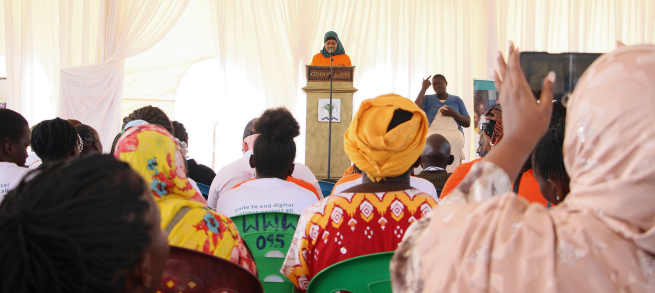
At the heart of a packed commemoration at Godoma Technical Training Institute, where county and national leaders joined women’s rights advocates, the message was clear: violence against women has not gone away — it has evolved. This year’s theme, “UNiTE to End Digital Violence Against All Women and Girls,” shone a spotlight on the growing danger of online abuse, harassment, stalking, non-consensual sharing of intimate images, cyber-bullying, and other forms of Technology-Facilitated Gender-Based Violence (TF-GBV).
Presiding over the ceremony, Hon. Rehema Jaldesa reaffirmed the commitment of the National Gender and Equality Commission (NGEC) to protect the rights, dignity, and safety of every woman and girl. Alongside H.E. Flora M. Chibule, Deputy Governor of Kilifi County, she issued a call to duty bearers and citizens alike to safeguard women’s digital and physical spaces, and to ensure that survivors receive support, justice, and opportunities to thrive. “When a woman’s voice is silenced online, an entire community loses a voice,” she declared. For too long, digital violence has remained invisible; today, Kenya resolves to bring it into light.
Across Kenya, smartphones and social media — once heralded as tools of empowerment — have increasingly become conduits of abuse. Reports of women and girls facing threats, harassment, blackmail, stalking, impersonation, and non-consensual circulation of images have surged in recent years.
A 2024 study of students in Nairobi’s tertiary institutions revealed that nearly 90 per cent had witnessed technology-facilitated gender-based violence, and 39 pc had experienced it personally. Female students were disproportionately targeted: 64.4 pc of them reported at least one form of online violence, compared with 35.5 pc of male students.
These digital assaults are more than fleeting insults. Women who endure them often suffer lasting psychological trauma, withdraw from social or academic life, and face risks of offline violence, social exclusion or economic loss. Cyberbullying, doxxing, online sexual exploitation and nonconsensual pornography are among the most common forms reported.
Globally, digital violence remains a critical challenge. According to UN Women, studies suggest that between 16 and 58 per cent of women and girls have experienced technology-facilitated violence at some point.
In Kenya, a recent report titled Technology-Facilitated Violence Against Women and Girls (TFVAWG) estimated that as many as 99.3 pc of women and girls accessing the internet have endured some form of online abuse — from threats and harassment to emotional mistreatment.
These figures confirm a painful truth: the digital revolution has opened new opportunities, but also new fronts in the struggle for women’s safety and rights. Digital violence has not replaced physical violence — it compounds it. Kenya continues to report alarming levels of sexual, physical, and intimate partner violence. According to the most recent national surveys, a significant proportion of women between the ages of 15 and 49 have experienced physical or sexual violence at some point.
Moreover, in many documented cases of femicide or fatal violence against women, the perpetrators are known to the victims — intimate partners, relatives, or acquaintances. These acts of brutality are often preceded or accompanied by emotional, economic, or digital abuse, illustrating how different forms of violence intersect and escalate.