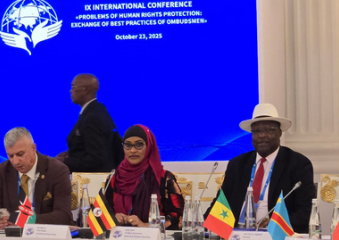
In Moscow, the international spotlight was turned toward the evolving intersection of technology and human rights when the National Gender and Equality Commission (NGEC) took its place among global partners shaping tomorrow’s digital agenda. The Commission’s Chairperson, Hon. Rehema Dida Jaldesa, along with Vice Chairperson Mr Thomas Koyier, participated in the IX International Scientific and Practical Conference on “Protection of Human Rights in the Context of Digitalization of Society,” a gathering of human rights institutions, policymakers and technology stakeholders from across the world.
At the core of Chairperson Jaldesa’s address lay a clear message: digital technology has revolutionised citizen-state relations, expanded access to justice and unlocked civic voice but it has also introduced new arenas of risk which demand vigilant protection of rights.
“Technology has revolutionised how institutions engage with citizens and enhanced access to justice,” she noted. “But it has also created new challenges that require vigilant protection of privacy, the prevention of online abuse, and the promotion of digital inclusivity.”
She further elaborated that Kenya’s stance on digitalisation is anchored on three defining pillars: inclusion, protection and accountability. “As technology continues to reshape our societies, we must ensure that no one is left behind, that individual rights are respected, and that institutions remain accountable in the digital space,” she affirmed. These pillars, she argued, serve as a framework for ensuring that the digital transformation of services, governance and economy does not undermine but rather advances human dignity.
Jaldesa also highlighted the cooperation between NGEC and international partners. She referenced the memorandum of understanding signed in 2024 between NGEC and the Office of the High Commissioner for Human Rights in the Russian Federation, which commits both institutions to collaboration in human rights education, information sharing and institutional capacity building. With this accord, Kenya deepens its engagement in global human rights discourse and affirms that the protection of digital rights transcends borders.
Throughout the conference, discussions ranged from data protection and digital justice to artificial intelligence and the perils of online misinformation. A recurring theme was the dual nature of technology as both enabler and disruptor and the corresponding need for national institutions to evolve. Vice Chairperson Koyier underscored the point, stating, “It is not enough to react to harm once it occurs. We must anticipate threats, empower citizens with digital literacy, and build systems that make accountability part of the architecture of technology itself.”
Kenya’s participation at the forum signals more than a symbolic gesture. It reflects the country’s commitment to being a proactive contributor to international norms around digital rights, and the NGEC’s role as a champion of equality, dignity and justice in both offline and online spaces. For young Kenyans, persons with disabilities and women who risk being marginalised in rapid digital shifts, the pronouncements from Moscow carry real weight: that their rights matter, their inclusion is imperative, and their protections must be built into the systems of tomorrow. Ultimately, the discussions underscored a central truth: technology alone does not guarantee progress. It must be anchored in strong human rights frameworks, institutional accountability, and the unwavering commitment to equality.