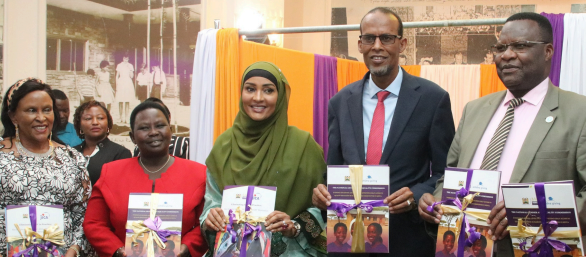
The first of its kind report by the National Gender and Equality Commission (NGEC) on girls’ education, launched last year, is redefining the national dialogue on learning opportunities for marginalized communities. Titled Evidence on School-Level Factors Affecting Girls’ Access to Quality Education in Marginalized Communities in Kenya, the study systematically examines the school level determinants of girls’ educational outcomes, exploring governance, retention, school environments, health, safety, and socio-cultural dynamics. By integrating school data, community perspectives, and policy analysis, the research identifies systemic barriers and actionable opportunities to improve access, quality, and equity in education.
During the launch at Sarova Stanley, Nairobi, Dr. Elyas Abdi Jillaow, Director General in the Ministry of Education, delivered the keynote on behalf of Cabinet Secretary Hon. Julius Ogamba. He welcomed NGEC’s commitment to education, noting the Commission’s persistent calls to safeguard capitation, highlight risks from delayed funding, and address sexual harassment in schools. Dr. Elyas affirmed that these calls for accountability strengthen the Ministry’s reform agenda and support ongoing efforts to make education inclusive and responsive to the most vulnerable learners.
Highlighting the Ministry’s response to the report, Dr. Elyas emphasized the need to strengthen leadership and governance in education. He committed to working with county education boards to roll out structured gender-responsive leadership training, reinforce adherence to gender representation standards in Boards of Management and Parent Teacher Associations, and integrate gender markers into school improvement plans.
He also reaffirmed the Ministry’s nationwide rollout of the ongoing pilot on value-based education, which seeks to instill character, citizenship, and responsibility among learners while shaping school culture and community engagement.
Addressing access, transition, and retention, Dr. Elyas noted that the School Re-entry Guidelines remain central to protecting the futures of pregnant and parenting learners, and that their enforcement will be strengthened.
The Ministry plans to expand targeted bursaries for learners at risk of dropping out, improve school infrastructure including water and lighting solutions, and scale flexible learning pathways, including community-based learning points, to ensure continued education without stigma or traumatization.
The report also highlighted gaps in health, WASH, and school safety, including disability inclusion, menstrual hygiene, and exposure to gender-based violence.
Dr. Elyas stated that, in coordination with the Ministry of Health, the Ministry of Education will prioritize investments in sanitation facilities, provide sustainable menstrual hygiene support, and conduct periodic School Health Compliance Reviews.
These measures will feed into sector-wide planning and NGEC reporting, ensuring that learner wellbeing, safety, and dignity are recognized as fundamental obligations rather than optional components of school management.
Harmful social and cultural practices, including early marriage, school-related gender-based violence, and limited adolescent sexual and reproductive health education, remain significant barriers.
Dr. Elyas highlighted plans to scale structured life skills education within the Competency-Based Curriculum, strengthen referral pathways for learners affected by violence, and engage communities, including elders, faith leaders, women’s groups, and youth advocates, to shift norms that restrict girls’ autonomy and aspirations. He stressed the importance of schools having simple guidelines to detect, report, and prevent repeated incidents of violence, reinforcing the protections afforded under the Children Act 2022, the Prohibition of Female Genital Mutilation Act 2011, and the National Policy on the Elimination of Child Labour.
The launch also drew attention to the link between education and clean energy access. Dr. Elyas observed that reliable renewable energy in schools and households not only reduces domestic labour burdens on children but also improves safety, expands digital learning opportunities, and strengthens overall equity in educational outcomes. The Ministry, in partnership with the Ministries of Energy and Environment and Forestry, is committed to supporting initiatives that integrate green energy solutions into schools as part of Kenya’s broader green transition agenda.
Dr. Elyas concluded by noting the importance of NGEC’s four-year national gender research agenda, which provides a framework for evidence generation that will guide government investments, shape targeted interventions, and strengthen accountability under Vision 2030 and the Medium Term Plan. He emphasized that the launch is more than a publication event; it is a call to design policy, allocate resources strategically, and respond effectively to the lived realities of girls and vulnerable populations across Kenya. He congratulated NGEC for its leadership in evidence driven planning and reaffirmed the Ministry’s commitment to ensuring that every girl learns in safety, thrives, and steps confidently into the future.