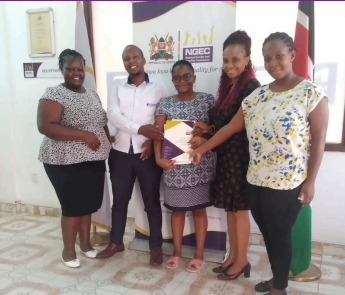
The National Gender and Equality Commission (NGEC) Malindi Regional Office hosted a delegation from Transparency International Kenya, drawn from its Mombasa and Nairobi offices, in a strategic engagement ahead of the launch of a Gender Equality and Social Inclusion (GESI) report in Mombasa County.
The meeting provided a platform for the Commission to receive a briefing on emerging findings from the report and to explore collaboration in addressing how corruption intersects with inequality and disproportionately affects vulnerable groups across Mombasa and Nandi counties. The forthcoming report is part of an ongoing GESI project implemented with support from the European Union through the Transparency International Secretariat. The initiative examines how corruption interacts with existing social and economic inequalities and seeks to promote governance systems that are inclusive, equitable and responsive.
During the engagement, stakeholders emphasised that corruption is not experienced uniformly across society. Instead, its effects are shaped by disparities in access to information, economic resources, institutional support and decision-making power.
Corruption within key service delivery sectors such as healthcare, education, water, housing and social protection was identified as a major factor that limits equitable access, particularly for individuals and communities already facing structural disadvantage.
Insights shared during the engagement were consistent with findings from the Kenya Gender and Corruption Survey 2025, which indicate that corruption has differentiated impacts across gender and social groups.
Discussions during the Malindi engagement identified persistent barriers that limit the effectiveness of anticorruption efforts. Stakeholders noted that reporting systems are often not designed to accommodate the needs of all citizens, particularly those facing physical, social or economic barriers.
Challenges such as inaccessible reporting platforms, stigma, fear of victimisation, and limited trust in enforcement institutions continue to discourage reporting of corruption cases. The Kenya Gender and Corruption Survey 2025 reinforces this concern, indicating that low reporting rates are closely linked to perceptions that complaints may not result in meaningful action, as well as fears of negative consequences for those who come forward. Participants emphasised that strengthening reporting mechanisms to ensure accessibility, confidentiality and responsiveness is critical to improving accountability outcomes. The engagement underscored the broader implications of corruption on service delivery and social equity. When public resources are misused or diverted, essential services become less accessible, particularly for those who depend on them most. Stakeholders noted that corruption can delay access to healthcare, limit educational opportunities, restrict access to social protection programmes and reduce economic opportunities for vulnerable populations. These impacts contribute to widening inequality and undermine efforts to achieve inclusive development. The discussions emphasised that addressing corruption requires a clear understanding of how its effects vary across different groups and contexts.
The meeting explored opportunities for collaboration in strengthening civic awareness, public education and community participation in accountability processes. Participants highlighted that inclusive governance systems depend on informed and empowered citizens who are able to access information, raise concerns safely and participate meaningfully in decisionmaking. Efforts to expand civic education were identified as essential in improving awareness of rights and responsibilities, particularly among Special Interest Groups. Stakeholders also emphasised the importance of creating safe spaces for community engagement to build trust and encourage participation in governance processes.
The engagement between NGEC and Transparency International Kenya reaffirmed the importance of partnerships in advancing inclusive governance and accountability. Both institutions identified areas of collaboration, including public awareness campaigns, community outreach initiatives and policy advocacy aimed at integrating Gender Equality and Social Inclusion into anti-corruption frameworks. The National Gender and Equality Commission continues to play a central role in promoting equality, nondiscrimination and inclusion across governance systems. Through its engagement in anti-corruption initiatives, the Commission advocates for approaches that address structural inequalities and ensure that public institutions are accessible and responsive to diverse population groups.