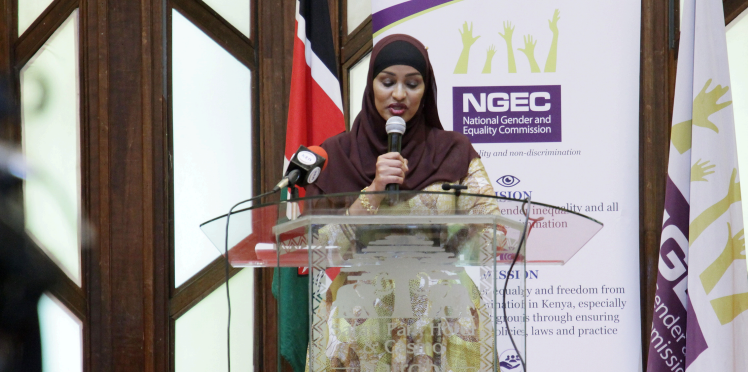
The launch of the National Gender and Equality Commission’s (NGEC) Strategic Plan 2025–2029 doubled as a powerful pitch for meaningful resourcing and a timely show of political support from Parliament. In her keynote remarks, NGEC Chairperson Hon. Rehema Dida Jaldesa laid out a candid case for funding, grounding her appeal not in sympathy, but in constitutional obligation and institutional accountability. She was promptly backed by Hon. Alice Ng’ang’a, Chairperson of the National Assembly’s Departmental Committee on Social Protection, who pledged Parliament’s support to ensure NGEC is adequately equipped to deliver on its expanded mandate.
Speaking at Safari Park Hotel, Hon. Jaldesa reminded guests that the Commission’s mandate—to promote equality and freedom from discrimination —is rooted in the Constitution and is central to the life of the nation. Yet, she noted, this mandate has been persistently underfunded. “Together, our first two strategic plans were costed at nearly Ksh. 9 billion. What we actually received over 10 years was about half of that. For a constitutional Commission whose work touches the soul of the nation—equality, dignity, protection—this is more than a budget issue. It’s a measure of national will,” she said. The newly launched 2025–2029 Strategic Plan is costed at Ksh. 7 billion and seeks to sharpen the Commission’s policy and oversight role across a dynamic range of challenges—from political exclusion and gender-based violence to digital equity, climate justice, peace disruption, and the economics of inclusion. “This Plan is not areinvention. It is a continuation—with sharper tools, clearer direction, and deeper resolve,” Jaldesa noted, adding that the Plan also reintroduces a strengthened awards and sanctions framework to reward progress and call out regression in equality and inclusion.
Jaldesa urged government, civil society, and development partners to treat the Strategic Plan as a shared national priority. “We are not just seeking resources; we are calling for seriousness,” she stated. “Equality cannot be deferred. Inclusion cannot remain aspirational.”
Hon. Alice Ng’ang’a echoed this appeal, calling the Strategic Plan both focused and realistic, noting that it draws heavily from the Commission’s past experiences and lays out a practical roadmap for deepening impact. She singled out the Plan’s intention to expand NGEC’s physical footprint by at least five regional offices, describing it as a deliberate move to bring protection, redress, and public awareness closer to communities. “Equality must be felt where people live,” she said. In her firm commitment to the Commission, Hon. Ng’ang’a declared, “As Chair of the Departmental Committee on Social Protection, I publicly affirm our support in ensuring the Commission is adequately resourced to deliver on this mandate.” She also promised stronger legislative backing, adding, “Beyond financial support, we are committed to ensuring that NGEC’s reports, once submitted to Parliament, receive timely attention and action.”
As the Strategic Plan enters the implementation phase, NGEC now stands on stronger ground, bolstered by Parliament’s commitment and a clear message that the work of inclusion deserves not only applause but also investment. The coming years will test how well this goodwill is translated into budgets, action, and results but the foundations are now firmly laid
.JPG)