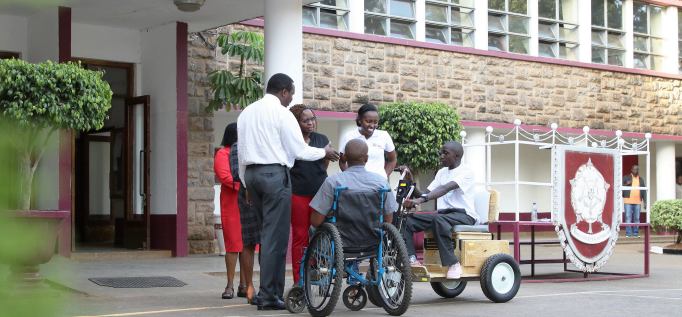
An allegation that a learner with a disability was turned away on reporting day at Lenana School has ignited a national conversation about what inclusion really means in Kenya’s schools. What seemed like an isolated incident quickly became a test of the country’s commitment to its constitutional promise of quality education for every child. The National Gender and Equality Commission (NGEC) responded swiftly with a fact‑finding visit, drawing school leadership, parents, legal team and partners into a complex dialogue about rights, resources, and readiness.
At a time when the education sector is gearing up to implement Senior School Education under the Competency‑Based Curriculum (CBC) starting January 2026 — reshaping secondary education into a more pathways‑oriented and learner‑centered model — the Lenana episode has thrown into sharp relief the distance between policy ideals and classroom realities.
At a time when the education sector is gearing up to implement Senior School Education under the Competency‑Based Curriculum (CBC) starting January 2026 — reshaping secondary education into a more pathways‑oriented and learner‑centered model — the Lenana episode has thrown into sharp relief the distance between policy ideals and classroom realities.
Inclusive education is not simply a phrase on a policy page; it is a lived experience for learners who, every day, must navigate physical, social and instructional barriers to learn alongside their peers. At its essence, inclusive education insists that every child — regardless of ability, background or circumstance belongs and thrives in mainstream classrooms. This requires not just access, but support, dignity, and genuine participation.
During the NGEC’s fact‑finding mission, the Commission engaged with school leadership, teachers, parents and learners. The process was marked by transparency and willingness to engage, with the Commission thanking the Lenana School community for their cooperation. School Principal William Kemei publicly reaffirmed Lenana’s commitment to being “a safe, respectful and welcoming space for every child,” a declaration that carried both reassurance and challenge. It underscored that inclusion is not only institutional policy but lived culture — and culture must be cultivated every day.
The Lenana School incident unfolds against the backdrop of one of the most sweeping reforms in Kenya’s education history: the rollout of Senior School Education under the CBC framework. Beginning in January 2026, Grade 9 learners will transition into Senior School (Grades 10–12), a stage designed to deepen learner competencies, align education with real‑world pathways, and prepare young people for tertiary education, further training, and the world of work.
For learners with disabilities, these preparations must go beyond physical spaces. They demand adapting curricula and learning support that recognizes diverse abilities, offers appropriate accommodations, and fosters genuine participation. The Ministry’s Implementation Guidelines for the Sector Policy on Learners and Trainees with Disabilities emphasize differentiated curricula, adapted assessments, teacher training, and the use of alternative communication modes such as sign language and Braille.
Yet implementation remains uneven. While policy frameworks affirm equitable access and differentiated support, on‑the‑ground realities in many schools reflect gaps in teacher preparedness, accessible infrastructures, and tailored learning support. These gaps demand urgent attention.
The Lenana incident, and the broader transition to Senior School Education, remind us that inclusive education cannot be achieved by schools in isolation. It requires a collective national effort — from policymakers and administrators to teachers, parents, and communities.
.JPG)