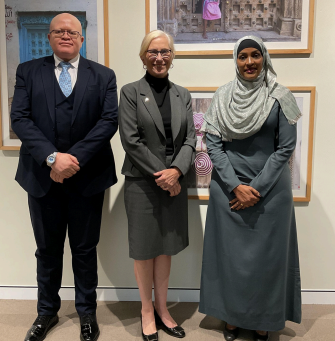
The Commission has opened a new chapter in international collaboration following high-level talks with the Australian High Commission in Nairobi. The meeting, held at the Australian High Commission offices, brought together NGEC Chairperson Hon. Rehema Jaldesa and Australian High Commissioner H.E. Jenny Da Rin in a strategic dialogue that could shape joint action on some of Kenya’s most pressing equality and inclusion challenges.
The discussions were grounded in a shared commitment to human rights, gender equality, and inclusive development. With both institutions expressing strong alignment in values and approach, the meeting focused on identifying concrete areas where mutual support can deliver tangible impact on the ground.
At the centre of the conversation was climate justice, particularly the need to design locally responsive, inclusive resilience strategies in arid and semi-arid regions. The two institutions noted that climate change is not just an environmental issue, but also a driver of gender-based vulnerability, displacement, and deepening inequality. They explored how targeted support could empower communities—especially women and girls in high-risk regions—to lead in climate adaptation efforts.
Another focal point was women’s economic empowerment. Hon. Jaldesa and High Commissioner Da Rin explored opportunities to support skills development and vocational training for girls, young mothers and women in hardship areas. The role of the Australia Awards Alumni network emerged as a key bridge for knowledge transfer and mentorship, particularly in building local leadership and enterprise capacity among women.
The talks also turned to the state of political participation and safety for women, especially ahead of the 2027 general elections. The Commission highlighted the need for robust civic education, legal support and communitybased protection measures to ensure women can fully and safely participate in political processes. There was mutual interest in supporting womenled peacebuilding initiatives in conflict-prone regions, drawing on Australia's experience in mediation and community dialogue.
Accessibility and inclusion for persons with disabilities also featured in the dialogue, with specific interest in advancing inclusive infrastructure, digital access to public services and rights-based planning frameworks. Both sides acknowledged the value of technical cooperation in these areas, particularly through staff exchanges and shared learning opportunities.
The meeting closed with a joint expression of readiness to co-create measurable, pilot-ready initiatives that can be rolled out in the short term. Australia’s Direct Aid Program was identified as a possible entry point to activate initial collaborations.
.JPG)