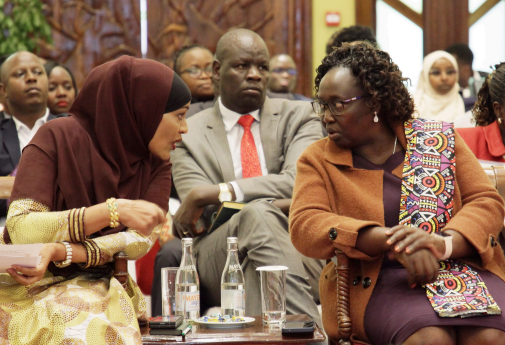
The Government has reaffirmed the National Gender and Equality Commission’s (NGEC) constitutional oversight mandate and committed to deepening collaboration with the Commission, including reinstating gender mainstreaming indicators in the national performance contracting framework. This policy affirmation was announced by Hon. Hanna Wendot Cheptumo, Cabinet Secretary for Gender, Culture and Children Services, during the launch of NGEC’s Strategic Plan 2025–2029 and the 2025 Usawa Awards held at Safari Park Hotel, Nairobi.
In a strong show of support for the Commission’s watchdog function, CS Wendot described NGEC as “the country’s constitutional compass on equality and non-discrimination,” adding that its role is not merely ceremonial but critical: “to watch, to remind, to guide, and yes, when necessary, to challenge.”
“The Ministry recognizes this oversight role as a key complement to our policy development and implementation role,” she stated, positioning NGEC as an indispensable partner in translating legal guarantees into institutional action. One of the most consequential policy pronouncements in her address was the Ministry’s ongoing engagement with peers to reintroduce gender mainstreaming indicators in performance contracting guidelines —a move that would re-anchor accountability for inclusion across Ministries, Departments, and Agencies (MDAs).
“My Ministry’s aspiration is that MDAs will not just be measured by outputs and shillings spent, but by how those outputs advance inclusion and dignity,” she said. “In so doing, gender equality shall be a metric of performance in service delivery.”
The announcement comes at a critical time, as calls for more meaningful and measurable inclusion gain momentum across the country, particularly among youth, women, and marginalized populations. If adopted, the reintroduction of these indicators would reverse a multi-year gap that left many institutions with little incentive to prioritise gender equality and social inclusion in their annual work plans. Beyond policy alignment, the CS reiterated the Ministry’s commitment to increasing financial resourcing for both NGEC and the State Department for Gender Affairs and Affirmative Action, noting that the two institutions despite their critical mandates remain among the most underfunded. “Yet their work touches the most vulnerable, that should ideally get higher resource allocations,” she observed. “I will use my voice at the Cabinet table to elevate the gender machineries’ mandates and lobby for substantive and sustained resources.”
CS Wendot further commended NGEC’s growing footprint and grassroots visibility across counties, noting the complementarity between the Ministry’s 46 county gender officers and the Commission’s expanding reach. She also acknowledged NGEC’s proactive role in shaping policy discourse on child protection, gender-based violence, femicide, and constitutional reforms related to the two-thirds gender rule. Significantly, she invited deeper partnership between the Ministry and NGEC, especially in areas where their mandates align, saying: “We are your policy partner, not your competitor.”
This alignment is especially critical as the Ministry rolls out the newly completed National Male Engagement and Inclusion Strategy, a policy shift that affirms the place of men and boys as not only allies in the gender agenda, but also as individuals with unique vulnerabilities requiring attention. The CS argued this marks a new phase in gender mainstreaming that “leaves no one behind.”
The speech marked a defining moment in government-Commission relations, one that places NGEC at the centre of national planning and delivery on equality and inclusion. With a strong public affirmation of its mandate and a renewed commitment to structural reform, the Commission’s Strategic Plan 2025–2029 enters implementation with rare momentum and political backing. As CS Wendot put it: “Let us, together, convert the bold words of this Plan into lived realities… for every Kenyan whose dignity still hangs in the balance.”