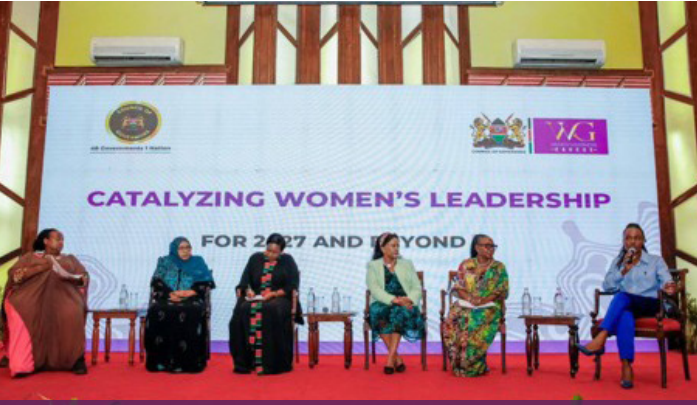

The National Gender and Equality Commission (NGEC), in partnership with the Hanns Seidel Foundation Kenya, convened the Quarterly Coordination Meeting on Peace and Security, bringing together youth leaders from across the country. The message was unmistakable: if Kenya is to achieve lasting cohesion, its young people must be at the centre of the conversation.
The one-day forum was more than talk. Participants drilled into practical skills — conflict resolution, mediation, grassroots advocacy — and pored over Kenya’s laws and policies on peace and integration. By day’s end, they had sketched actionable strategies: youth-led peace committees in conflict-prone counties, digital campaigns against hate speech, and stronger ties between county governments and youth networks.
The meeting pulsed with determination, with energy sharpened into strategy. The agenda was unapologetically practical: training in conflict resolution, mediation, and grassroots advocacy, and a deep dive into Kenya’s policy and legal frameworks guiding peace and security. Discussions crackled with urgency, moving beyond rhetoric to hammer out concrete strategies — from establishing youth-led peace committees in conflict-prone counties to mounting digital campaigns to counter hate speech, and demanding stronger partnerships with county governments.
For NGEC, the meeting was a call to action grounded in the Constitution itself. Article 55 obliges the state to ensure youth participation in political, social, and economic life. Yet too often, that promise is treated as symbolic. “Peacebuilding cannot be sustainable when half the population is treated as outsiders,” an NGEC representative said.
The Hanns Seidel Foundation echoed the sentiment, warning that any peace process without youth at its core is “a house built on sand.” The Foundation has long invested in governance and civic education in Kenya, but the Nairobi forum underscored that peace and security are no longer matters for state security organs alone — they are matters of everyday citizenship, and youth are its frontline guardians.
Kenya’s peace remains fragile, tested time and again — by bitter elections, by competition for land and resources, by misinformation spreading like wildfire online. Each crisis has underscored the same lesson: laws and police presence alone cannot hold the centre. Stability requires trust, and trust grows only when communities feel represented, heard, and invested in the outcome.
That is where Kenya’s youth come in. They are the majority — nearly 70 percent of the population is under 35. They are the digital generation, fluent in the language of mobilisation, whether in village barazas or on TikTok. They are also the demographic most often manipulated, ignored, or vilified when peace falters. To leave them out of national peacebuilding is not just short-sighted; it is dangerous.