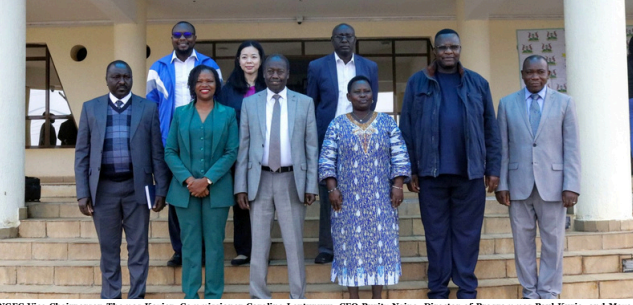
In Kabarnet, Baringo County, a high‑level delegation from the National Gender and Equality Commission (NGEC) led by Vice Chairperson Thomas Koyier, Commissioner Caroline Lentupuru, and Chief Executive Officer Purity Ngina met with Governor H.E. Benjamin Cheboi to advance strategic partnership efforts with the Japan International Cooperation Agency (JICA) on eliminating Gender‑Based Violence (GBV).
The discussions unfolded against the backdrop of a growing national focus on GBV as a persistent social challenge, with authorities and civil society alike calling for more robust prevention, survivor support systems and coordinated responses. Recent national data show staggering levels of violence against women and girls, with one in three women globally experiencing physical or sexual violence in their lifetime a pattern that is reflected in local realities across Kenya.
Governor Cheboi acknowledged the heavy toll that GBV has on families and communities in Baringo, identifying insecurity, entrenched harmful norms and ignorance about rights as key drivers of the problem. He welcomed the proposed partnership with JICA and urged support for the establishment of a GBV safe house in the county a facility that could offer secure shelter and psychosocial support to survivors as they pursue justice and recovery.
The NGEC delegation, joined by Maya Soma, Chief Advisor for the JICA GBV Elimination Project, reaffirmed a shared commitment to strengthen survivor‑centred prevention and response interventions. The approach emphasizes coordinated action in areas affected by conflict and heightened vulnerabilities, with particular attention to emerging threats such as technology‑facilitated abuse an issue gaining national visibility as part of broader GBV trends.
The Commission highlighted its role in promoting equality and non‑discrimination, noting that GBV not only undermines the dignity and security of individuals but also erodes community cohesion and economic participation.
The partnership with JICA, which spans training, policy engagement and innovative community outreach, seeks to bolster local capacities to prevent and respond to violence through evidence‑informed, culturally sensitive practices.
JICA’s involvement reflects a growing trend in multi‑sector engagement to address GBV. Across Kenya, organizations and government agencies are co‑creating programmes that combine policy reform, awareness raising and practical service delivery — acknowledging that lasting change demands both institutional coordination and grassroots commitment.
The delegation also held talks with Baringo County Commissioner Stephen Kutwa, who noted progress in stabilizing local insecurity through community sensitization and strengthened patrols. Commissioner Kutwa emphasised the need to deepen public education on the root causes of GBV, including harmful gender norms and power imbalances that persist in some settings.
Stakeholders agreed that strengthening county coordination mechanisms including referral pathways, data tracking and integrated support services remains essential to ensure that survivors receive timely support and that preventative strategies are effective.
The emphasis on multi‑level collaboration aligns with national GBV priorities, which call for a comprehensive response that cuts across law enforcement, healthcare, social services and community structures. Experts and national task forces have highlighted the importance of survivor‑centred, trauma‑informed approaches that prioritise dignity, safety and justice at every stage of intervention.
Emerging forms of violence, including digital and technology‑facilitated abuse, featured prominently in the discussions. As Kenya grapples with rapid changes in how people communicate and engage online, both institutional and community actors recognise that protective mechanisms must evolve accordingly.
The NGEC and JICA team underscored the importance of equipping frontline responders with tools and knowledge to detect, prevent and respond to such forms of abuse particularly among young people and vulnerable groups whose lives are increasingly entwined with digital platforms.
These priorities reflect a broader shift in GBV prevention and response, where traditional service models are complemented by innovative strategies that address behavioral norms, technological contexts and community mobilization.
The engagement in Baringo is part of a wider national effort to tackle GBV through partnerships that combine policy influence, capacity building and practical support on the ground.