
NAIROBI — As Kenya accelerates toward a technology-driven economy, a critical question continues to shadow that progress: who gets to participate, who gets protected, and who gets left behind?
That question took centre stage as the National Gender and Equality Commission (NGEC) hosted Priscilla Kerebi of EdSource Africa alongside representatives from Silicon Savannah Woman, a Konza Technopolis initiative, for high-level deliberations on advancing women’s participation in the digital economy. What unfolded was not a courtesy engagement, but a strategic convergence of policy, innovation and gender justice aimed squarely at reshaping Africa’s digital future.
At the heart of the discussions was the persistent digital gender gap that continues to limit women’s access to opportunity. While Kenya has positioned itself as a regional technology hub, women and girls remain disproportionately excluded from digital skills training, financing, innovation ecosystems and leadership in science, technology, engineering and mathematics (STEM).
The leaders examined how unequal access to devices, connectivity, capital and mentorship compounds existing social and economic inequalities. These gaps, they noted, are further entrenched by online safety risks including cyber-harassment, digital surveillance and technology facilitated gender-based violence which discourage women from fully participating in digital spaces.
Beyond access, discussions delved into systemic barriers within the current policy and institutional landscape that continue to slow inclusive digital transformation.
Despite growing investments in innovation, gender considerations often remain peripheral in technology policy, funding frameworks and emerging AI governance models.
NGEC emphasised that without safe digital environments, efforts to promote women’s economic empowerment through technology remain incomplete. The Commission underscored the need for stronger accountability mechanisms, gender-responsive digital policies and survivor-centred responses to online harm.
Discussions also examined critical gaps in Kenya’s current policy landscape. While investments in innovation and digital infrastructure continue to grow, leaders noted that gender considerations are often insufficiently integrated into technology policy, funding frameworks and emerging regulatory systems.
Representatives from Silicon Savannah Woman pointed to the persistent underrepresentation of women in STEM education, research and entrepreneurship, warning that without deliberate intervention, the digital economy risks replicating long-standing social and economic inequalities.
As artificial intelligence increasingly shapes access to education, employment and public services, NGEC stressed that inclusive design, safety and fairness must be foundational principles of technological advancement.
Commission leaders cautioned that biased algorithms, unequal data representation and the exclusion of women from AI development and governance could deepen inequality if left unaddressed. Technology, they emphasised, must expand opportunity not encode discrimination into digital systems.
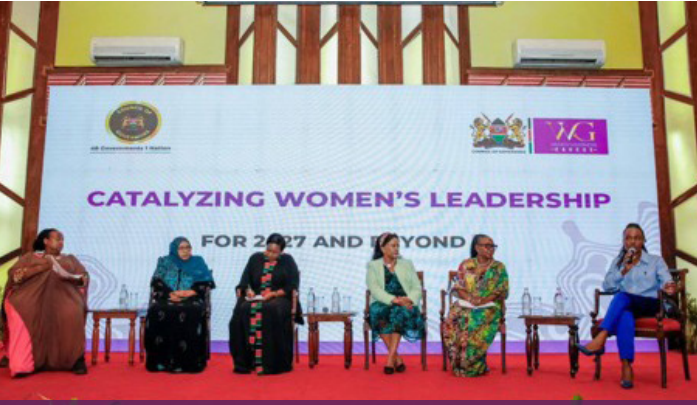
The engagement identified clear areas of convergence and joint action, with NGEC, EdSource Africa and Silicon Savannah Woman aligning on collaborative plans for Women’s Month in March 2026.
The summit aims to generate actionable pathways for gender-inclusive digital growth, with ambitions that extend beyond Kenya to influence Africa’s broader digital transformation agenda.