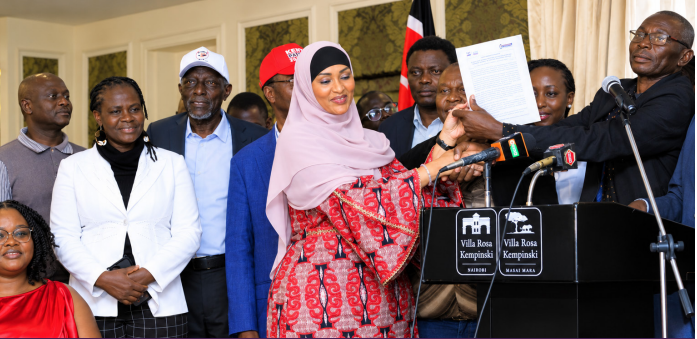
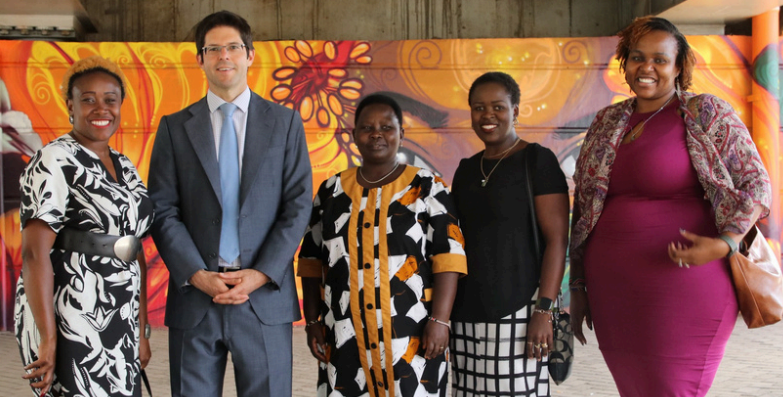
Along the Langata Road overpass near T-Mall, a striking public mural was unveiled this week as part of the 16 Days of Activism Against Gender Based Violence, transforming a routine urban passage into a site of reflection, resistance and resolve. The event, hosted by the Embassy of Spain in partnership with the Kenya Urban Roads Authority (KURA), brought together diplomats, government representatives, artists and gender equality advocates united by a shared purpose: to confront violence against women and girls and to reclaim public spaces as platforms for dignity and justice.
Among those present was Commissioner Lentupuru, whose participation underscored the Commission’s continued commitment to advancing equality, strengthening accountability and supporting national efforts to safeguard the rights of all women and girls.
Unlike decorative urban art, the Langata Road mural is designed as a social intervention. Through layered imagery and symbolic expression, it provokes reflection on the physical, psychological and social toll of gender based violence, while simultaneously celebrating resilience and survival. The artwork speaks to experiences often relegated to private spaces such as homes, institutions, and communities and brings them into the public eye, where silence is harder to sustain and denial more difficult to justify.
Organisers emphasised that the mural’s intention is not to shock, but to awaken: to prompt conversations about consent, power, accountability and protection that extend beyond the 16 Days campaign and into everyday civic life. The choice of the Langata Road overpass was both strategic and symbolic.
As one of Nairobi’s busiest transport corridors, the site guarantees sustained visibility and engagement. Thousands of commuters including students, young workers and families encounter the mural daily, ensuring that its message reaches diverse audiences across age, class and background.
In reclaiming this space, the initiative highlights a crucial truth: public spaces reflect the values of the public. When messages of dignity and non-violence occupy shared infrastructure, they challenge the normalisation of harm and assert that safety is a collective responsibility.
The involvement of the Embassy of Spain highlights the role of international cooperation in advancing gender equality and human rights. Spanish cooperation has consistently supported initiatives that combine cultural expression with social justice, recognising art as a powerful vehicle for behavioural change and community engagement.
By partnering with KURA, the project also demonstrated how infrastructure institutions can play an active role in social transformation integrating gender considerations into spaces traditionally viewed as neutral or purely functional.
During the unveiling, Commissioner Lentupuru reaffirmed the Commission’s commitment to promoting equality, strengthening accountability and supporting national efforts to prevent and respond to gender-based violence. She emphasised that while public art can catalyse awareness, lasting change depends on strong systems — effective laws, survivor-centred services, coordinated institutions and sustained public education. The mural, she noted, should be seen as a starting point for deeper engagement, not an endpoint.
As Nairobi continues to grapple with high rates of gender-based violence, initiatives that disrupt silence and provoke public dialogue are increasingly vital. The Langata Road mural stands as a visual reminder that violence against women and girls is neither inevitable nor acceptable and that resilience, dignity and justice must be visibly defended. Long after the 16 Days of Activism conclude, the mural will remain confronting, questioning and calling on every passer-by to reflect on their role in building safer communities. In a city defined by motion, this wall asks Nairobi to pause and to choose accountability over indifference, and action over silence.