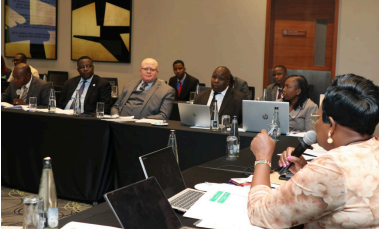
The National Gender and Equality Commission (NGEC) has participated in a strategic engagement with the Parliamentary Committee on Implementation of the Constitution, focused on strengthening the representation of Special Interest Groups (SIGs) across national and county governments as well as the wider public sector. The meeting addressed persistent gaps in the inclusion of women, youth, persons with disabilities, and marginalised and minority communities, with Members of Parliament calling for stronger enforcement of constitutional and policy provisions to ensure equitable participation in governance.
During the engagement, Members of the Parliamentary Committee expressed concern that representation of Special Interest Groups remains below the levels envisaged in the Constitution and related legal frameworks.
The discussions highlighted continued underrepresentation of women, youth, persons with disabilities, and minority and marginalised communities in decision-making structures across both national and county levels of government.
Lawmakers noted that despite existing legal provisions on equality and inclusion, implementation gaps continue to limit meaningful participation of these groups in public sector institutions. The concerns were framed within the broader constitutional requirement for inclusivity in governance, which seeks to ensure that all segments of society are represented in public decision-making processes.
Participants in the meeting identified structural and institutional barriers as key contributors to low representation of Special Interest Groups.
These include challenges in recruitment processes, limited targeted capacity building initiatives, and inadequate enforcement of inclusion policies across public institutions. The discussion also noted gaps in monitoring and reporting systems, which limit the ability to track progress on inclusion commitments and identify areas requiring corrective action.
Members emphasised that without deliberate measures, existing inequalities in access to public sector opportunities are likely to persist.
The Parliamentary Committee proposed a series of practical interventions aimed at addressing representation gaps.
These included strengthening enforcement of existing legal and policy frameworks that support inclusion, enhancing targeted recruitment practices, and expanding capacity building programmes for underrepresented groups.
The proposals also emphasised the need for improved monitoring and reporting mechanisms to track inclusion outcomes across all levels of government. Affirmative action measures were highlighted as a key tool for accelerating equitable representation and ensuring compliance with constitutional requirements.
The engagement underscored the importance of accountability mechanisms in ensuring that inclusion policies are effectively implemented. Participants noted that coordination between oversight institutions, including parliamentary committees and constitutional bodies, is critical in ensuring that government institutions comply with inclusion requirements.
The discussions also highlighted the need for regular reporting on representation of Special Interest Groups within public sector institutions to support evidence-based oversight and policy adjustments.
The National Gender and Equality Commission reiterated its constitutional mandate to promote equality and freedom from discrimination, with a specific focus on monitoring and promoting the inclusion of Special Interest Groups in governance and public service. The Commission continues to support government institutions in implementing inclusion frameworks, conducting assessments on representation gaps, and advising on corrective measures where disparities are identified.
Its engagement with the Parliamentary Committee reflects ongoing efforts to strengthen oversight and implementation of constitutional provisions on equality and inclusion. Members of the Parliamentary Committee reaffirmed their commitment to working collaboratively with relevant institutions to ensure full realization of constitutional provisions on equality and inclusion.
The engagement emphasised the shared responsibility of state institutions in ensuring that no group is excluded from participation in governance and development processes.
The strategic engagement between the National Gender and Equality Commission and the Parliamentary Committee on Implementation of the Constitution highlights renewed focus on addressing representation gaps for Special Interest Groups in public sector institutions.
With emphasis placed on enforcement, targeted recruitment, capacity building and accountability mechanisms, the discussions point to ongoing efforts to strengthen inclusive governance structures.
The outcomes of the engagement reaffirm a constitutional commitment to equitable participation, with a clear expectation that future reforms will prioritise measurable progress in ensuring that all groups are adequately represented in decision-making processes at all levels of government.