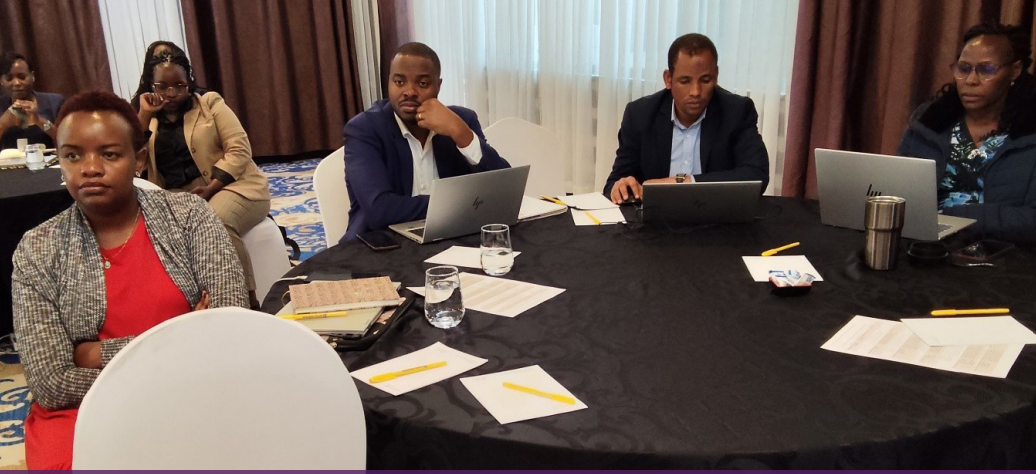
The Commission has convened the technical working group developing the Monitoring, Evaluation, Accountability and Learning (MEAL) framework for the Kenya National Action Plan for Inequality Reduction (KAPIR), taking the draft through detailed review and refinement ahead of validation and launch.
National plans on inequality rarely fail at the drafting stage. They fail afterwards, when no institution can say what changed, for whom, or whether public spending reached the households it was appropriated for. The MEAL framework is the instrument built to close that gap, converting the Action Plan’s theory of change into measurable results with named reporting responsibilities attached.
The draft framework translates KAPIR’s outcomes and outputs into indicators and annual targets, and assigns to each indicator the institution responsible for reporting it and the cost of collecting it. That last provision matters. Indicators without an owner and without a budget line are the standard point of failure in national monitoring systems.
Disaggregation is treated as a minimum standard rather than a refinement. Data collection tools are to capture information broken down by sex, age and disability at minimum, with further disaggregation where context requires it, and analysis is to be conducted by population group, geography and disadvantage. The reasoning is stated plainly in the draft: national averages make the most marginalised populations invisible, and a plan that reports only averages can record progress while the groups it was written for stand still.
Quality assurance runs in four stages, from validation of indicators and pre-testing of tools before any data is gathered, through field supervision and automated validation during collection, to documented cleaning, cross-validation against national survey and administrative data, and scheduled audits afterwards. A periodic independent assessment reviews the system itself and reports to the governance level above the technical one.
The framework also sets out who answers for what. The Commission is the strategic custodian, responsible for direction, resource mobilisation, quality assurance and dissemination. A steering committee provides governance oversight, the technical working group manages tools, data quality, capacity building and the risk register, priority area coordinators and implementing partners collect and report at operational level, and county structures localise collection and community feedback. Reporting products run from quarterly and annual progress reports to a midterm review and an end-term evaluation.
Data protection is built in rather than added. The framework applies tiered access controls governed by the Constitution, the Data Protection Act, 2019 and the Access to Information Act, 2016, and it treats those who supply data as rights holders rather than as sources. The distinction carries practical weight where information concerns survivors of gender-based violence, persons with disabilities, children and households in extreme poverty, and where a breach is not an administrative lapse but an exposure to harm.
INEQUALITY PLAN ACQUIRES THE MACHINERY TO PROVE WHETHER IT WORKS
The KAPIR MEAL framework sets out how progress will be measured, who reports it, and what disaggregated evidence must show before a programme can be called a success.
For the Commission the framework has direct operational consequence. Its mandate under the National Gender and Equality Commission Act, 2011 includes monitoring and auditing compliance with the principle of equality and freedom from discrimination across the public sector. That oversight depends on evidence generated by other institutions. Where implementing agencies do not collect disaggregated data, the Commission’s audit is confined to what can be inferred, and inference is not a basis on which to hold a duty bearer to account. The framework’s own test comes after launch. Its value will rest on whether the evidence it produces reaches planning and budgeting decisions rather than circulating within reporting cycles. The draft anticipates this by linking findings to governance agendas and to budget calendars. Whether that link holds is what the first full reporting cycle will reveal.