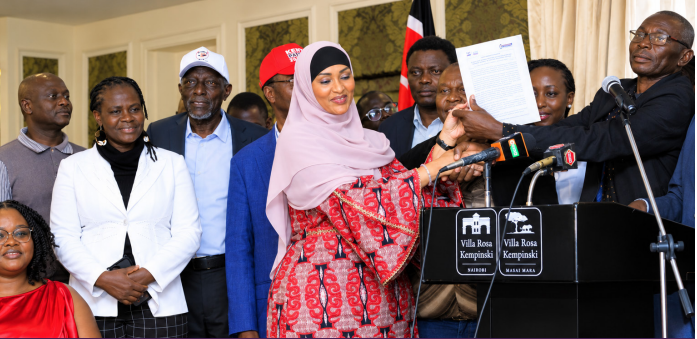
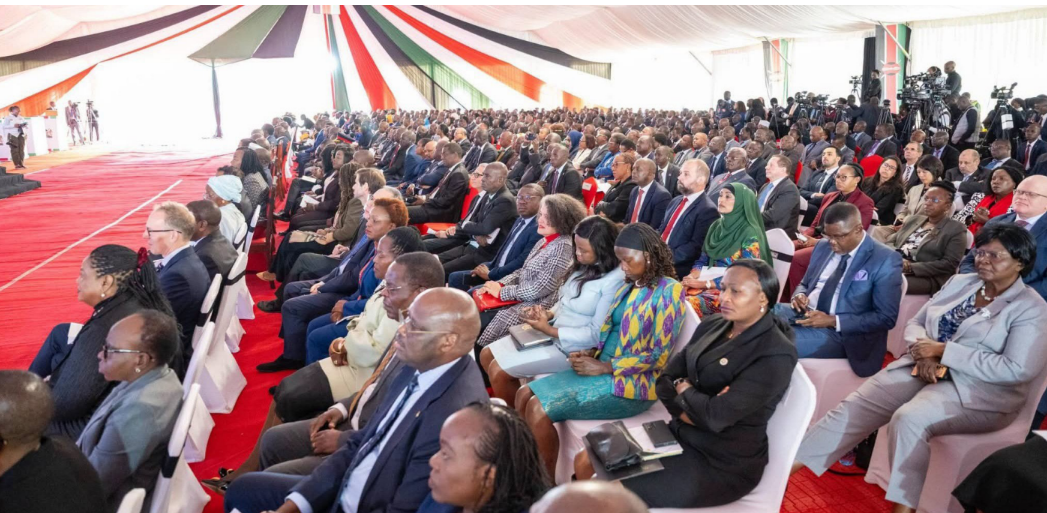
The Commission joined His Excellency President William Ruto, constitutional commissions and independent offices at the national commemoration of the sixteenth anniversary of the promulgation of the Constitution of Kenya, 2010, held at the Kenyatta International
Convention Centre on 27 August 2026.
The Chairperson, Hon. Rehema Jaldesa, and Commissioner Michael Nzomo represented the Commission. The Commission used the occasion to release a one page assessment of the implementation of Article 27, the provision that converts equality from a national value under Article 10 into an enforceable entitlement and supplies the operative meaning of Articles 53 to 57, 54(2), 81(b) and 100. The assessment reaches a conclusion the Commission states without qualification. Kenya has secured the norm. It has not secured the outcome. Compliance is reported. Equality is not delivered.
What the constitution has held
The record of the last thirteen years contains gains that did not exist before 2013 and that no honest assessment can set aside. Women now exceed 50 per cent of the judiciary. The Supreme Court meets
the not more than two thirds gender principle. Twenty six of the forty seven county assemblies seat members with disabilities. Youth sit in Parliament. The number of women serving in Cabinet and in government agencies continues to rise, and the gender function within devolved government is strengthening.
“At sixteen years, Kenya has secured the norm but not the outcome. Compliance is reported. Equality is not delivered.” These outcomes followed sustained institutional work. Between FY 2019/20 and FY 2024/25 the Commission handled 1,008 complaints, reviewed 229 laws and policies, issued 492 advisories and pursued 18 strategic cases. Agency reporting compliance now stands at 92 per cent.
Where the test fails
The same period produced measurable shortfalls under every constitutionally protected ground.
Persons with disabilities held 1.9 percent of parliamentary seats in 2017 and 2.0 per cent in 2022, against the 5 per cent floor set by Article 54(2). Twenty one county assemblies seat no member
with a disability. As at October 2024, three counties had a County Executive Committee member with a disability and seventeen had a youth member. The electoral data locates the obstacle precisely. In 2022, women were 1,962 of 16,100 cleared candidates, or 12 per cent. Success rates for women and men were both about 11 per cent. The barrier operates before the ballot, not at it.
In public employment, women are 40 per cent of the workforce and are concentrated in lower cadres. Persons with disabilities are 2 per cent, youth 18 per cent and ethnic minorities 6 per cent, with some sectors below 1 per cent. An audit of 32 public buildings found most premises entirely inaccessible to persons with disabilities.
The financing figure carries the argument. Gender and social inclusion functions account for 0.013 per cent of the national budget in FY 2025/2026. Public entities allocate under 0.05 per cent of their budgets to gender mainstreaming. An unfunded right, the Commission observes, is a declaratory right.
The private sector record follows the public one. Of audited companies listed on the Nairobi Securities Exchange, 40 per cent met the not more than two thirds principle and 9 per cent had no
woman on the board.
The structural cause
The assessment traces these results to a single omission. Articles 27,
81(b) and 100 have no guiding statute. Since 2011, fourteen legislative proposals on the not more than two thirds principle and three proposals on the operationalisation of Article 100 have failed. The Commission can establish non compliance. It cannot compel correction. Accountability therefore remains form driven and reactive, measured by reports filed rather than by conditions changed.
Five demands before 2027
The Commission has placed five priority actions before the State ahead of the 2027 electoral cycle.
One. Enact a law giving effect to the not more than two thirds gender principle under Articles 27(6) and 81(b).
Two. Enact the law giving full effect to Article 100 for the representation of persons with disabilities, youth and minority and marginalised communities in Parliament.
Three. Implement and enforce the socio economic frameworks already in place, among them the National Policy on Ethnic Minorities and Marginalised Communities 2025-2035, the Persons with Disabilities Act 2025, the Children’s Act 2022, the Kenya Youth De-
velopment Policy 2019 and Sessional Paper No. 02 of 2019 on the National Policy on Gender and Development.
Four. Resource the equality and affirmative action function across labour, education, governance, energy and natural resource management.
Five. Invest in future generations by protecting the right of every child to education, health care and dignity, and by expanding opportunity for youth in training, innovation and the creative sectors.
THE QUESTION THAT REMAINS
Sixteen years of practice have removed the interpretive questions. The text is clear, the jurisprudence is settled and the audit trail exists.
What remains is a choice about accountability. As the Commission putsit, the question before the country is no longer what the Constitution requires on equality. It is whether the State is prepared to be measured against it.